Showing posts with label books. Show all posts

Saturday, June 6, 2015

HOTEL MOSCOW-- The Surprises

[Note to readers: With the launch of HOTEL MOSCOW this week, I've been late in posting the May newsletter that had been sent last month to subscribers. Please write to MecoxHudson2@aol.com to receive your June mailing as soon as it is available.]

Hello to old friends who have read my previous novels, and hello to new ones that, I hope, will soon embark on a satisfying journey with Brooke Fielding, the protagonist of my new novel, HOTEL MOSCOW.

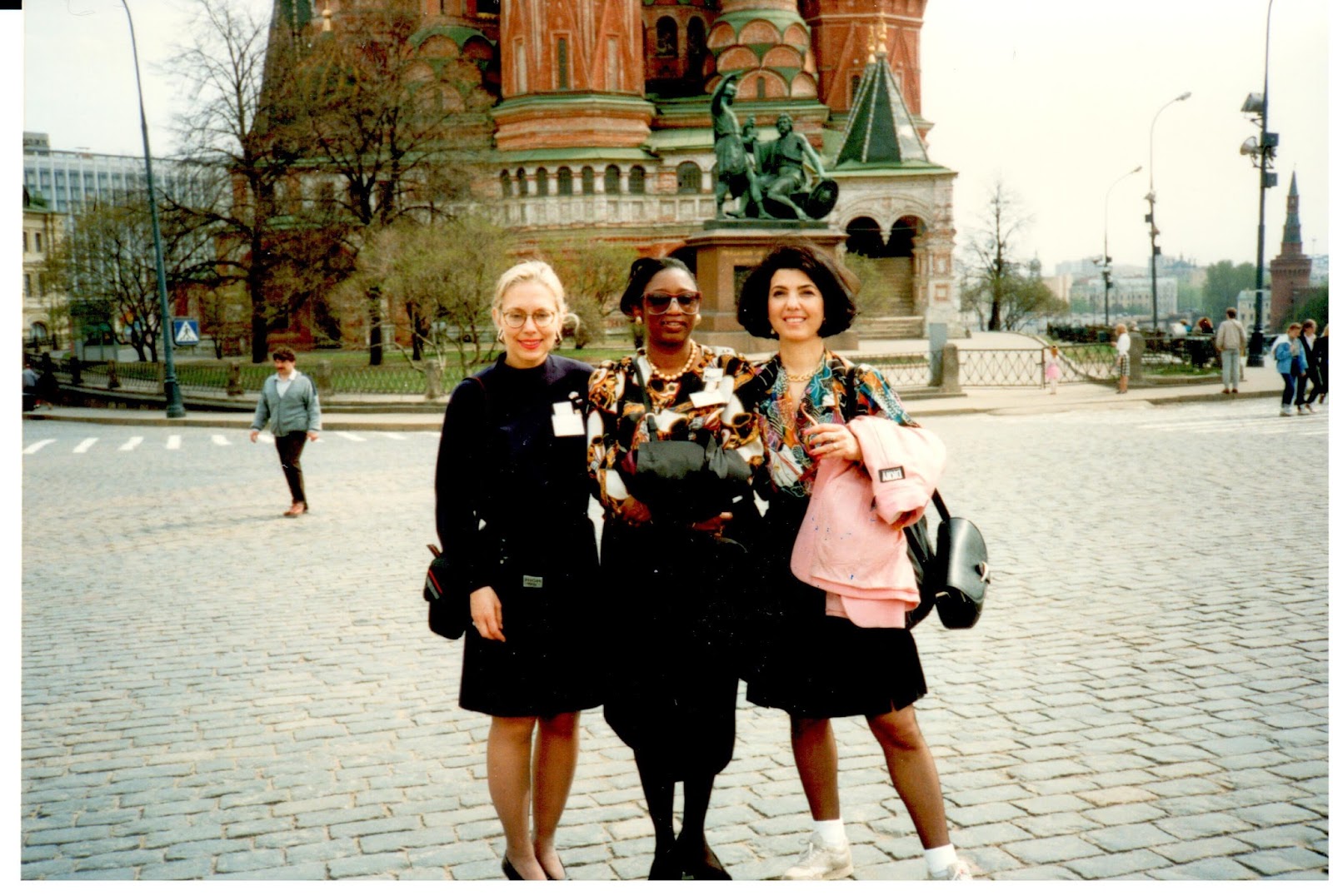
In my April newsletter—the first in this monthly series—I touched on how my experiences in Russia have finally materialized in HOTEL MOSCOW: I was a consultant to Fortune 500 companies when, in 1993, I was sent by the U.S. Information Agency to Russia to teach Russian women the entrepreneurial skills they needed after the fall of communism. On my second visit, in October, I was caught in the uprising of the Russian parliament against President Yeltsin, was chased by the militia and was threatened with jail.

THE SURPRISES
     
What equally terrified me in the midst of a civil war was seeing graffiti of Yeltsin's name with the letter L—a triangle in Cyrillic—turned into a Star of David. When I asked why, I was told, “The Jews are behind it.” 
       It was a sobering introduction to virulent anti-Semitism. Jews were again being blamed for events that had nothing to do with us! 

The second surprise happened on November 3, 1993 at 2:48 PM—just four weeks after my escape from Moscow—when I sat down and began to write fiction. 
       A story happens when the individual’s spirit clashes with the power of religion, social conformity, or political upheaval—and emerges victorious. And I’ve had quite a few stories to tell. But it took me to mature as a writer and have the perspective of time to return to this particular historical time and place. 

THE RESEARCH 
    
An over-arching situation sets the background for a novel and drives the plot, but often marginal fragments of research spin the story into a surprising, new orbit. 

In Moscow I had witnessed some of the uprising first hand, with hundreds of civilians attacking a large police unit, the heavy artillery military confrontation, and the burning of the parliament building. But to make sense of the events, back in the USA I attended lectures about the Russian politics of the time and interviewed Cold War-era US security personnel. I recorded personal accounts of recent Soviet immigrants about the suffering and tribulations of living at the bottom of the food chain in a corrupt society. Personally, while visiting Russia twice in 1993, I watched the most educated group of women I had ever met suffer the indignation that came from deprivation: When the famous food lines led to empty stores, these women were reduced to being gatherers and hunters almost like the African women I had counseled before.

HOTEL MOSCOW's unique themes:


       Brooke meets Russians conditioned to distrust after a lifetime of bankrupt ideology and empty slogans—and living in nightmarish communal apartments. They are trying to make sense of a bewildering world in transition from communism, a world where economic survival is critical yet overwhelmingly foreign. 
       On a different layer, HOTEL MOSCOW also has two strong Jewish themes: One is the legacy of second-generation, children born in freedom to Holocaust survivors. The other is the challenge of forging secular Jewish identity unrelated to faith. I wanted to juxtaposed these ideas against blatant anti-Semitism, and so I sent my protagonist to Russia to see how she would react. 

COMING UP:

It is exhilarating to meet book lovers. Please check my upcoming book tour schedule, starting in NY, NJ, and CT. (By August I’ll add my visits elsewhere.)

In my keynote speeches I talk about what happens to a society when women are excluded from participating in the public arena. I speak about the forged identity of an unaffiliated, secular Jew, or I discuss how stories find me.
     
Stay tuned: There is so much I want to tell you (and Skype with you in your book groups!) In my next newsletter I will write about the Kommunalkas—the communal apartments that were a lifelong nightmare which has left its mark on the Russian psyche.

The countdown to the release of HOTEL MOSCOW on June 2nd has begun. Now is the time to pre-order it at a great discount at  Amazon, B&NiTunes, or even better--support your indie bookstore. (My novels are published in paperback format to keep the price down.)

Thank you, former readers and future friends. I am looking forward to hearing from you,

Talia Carner


P.S. PRE-PUBLICATION REVIEWS:
       Endorsements for the book have been coming from bestselling authors of suspense thrillers. Nelson DeMille wrote: “HOTEL MOSCOW is a wonderful evocation of time and place and a post-Cold War thriller that will keep the reader mesmerized.” 
       Or Kirkus Reviews: “…a compelling narrative of lives lived in dystopia. The novel sheds much-needed light on this turbulent period in Russian history."

       For more pre-publication reviews from best-selling authors Andrew Gross, Tami Hoag, Ellen Mesiter, Rodney Barker, and Jay Neugeboren, please click here.


Monday, June 30, 2014

A Parisian Soirée


Jim Haynes with Author Talia Carner

          Tucked in a Parisian residential is an unkempt garden. Or rather, it is a pathway along the side of a building in which two-storey high windows allow peeks into artists’ ateliers. Just past a shed with boarded windows, one side of the path is planted with fruit trees. Take a few steps onto a narrow brick terrace, and you face the door to Jim’s world.
            Jim’s home is built upon a quirkily impressive history of literature and theater—and his love of people. The home has a kitchen that occupies one-third of the first-floor living area. In that kitchen, every Sunday evening for the past three decades, volunteers cook up a dinner for up to seventy strangers who’ve heard of Jim’s soirées.
             In our American standards—and perhaps in European standards, too—the living room is tiny for such an ambitious hosting. An upholstered bench runs along one wall, supplemented by a couple of chairs. Above them, a long shelf exhibits books by authors close to Jim’s heart.
             The real action of the evening, one soon discovers, is in the people who gather in that room, and by necessity, spill onto the terrace and the garden. A couple of ex-pats who’ve long settled Paris are helping around the party. The rest are either tourists from all corners of the globe seeking the flavor of old literary Paris, or temporary residents of Paris. It is easy to make introductions as one must squeeze close to a dozen people to fetch ice from the only commercial-size appliance in this otherwise modest dwelling that manages to whip up a meal for so many guests. The red and white wine, extracted from the spigots of cardboard pegs, help set the mood.
            I was first handed a bowl with three servings of three totally unidentified food. Each piece or mush challenged me with its different shape and texture, but I failed to guess what it was. Nevertheless, I trusted myself (and Jim) enough, and found the food to be quite tasty—yet still unidentified. Someone said this dish had Asian influence, and I was unable to argue one way or another. The main course was more familiar, though less edible, for the slab of meat that had never suffered the heat of fire or oven was to be consumed with only a fork. I recalled my visit to a French family back in the 1970s, where I was served my first raw meat, but it was eaten at the table, with the benefit of a knife.
            Even though we were all Jim’s guests, in his e-mail he suggested a 30 Euro donation (about $40) per person. He asked that the money be discretely placed in a recycled envelope, while Jim, sitting high on a stool at the back of the room, welcomed every person and ticked them off his list, noting the envelopes. One guest speculated that the octogenarian Jim landed a weekly income, cashing in on his long reputation and the media exposure his evenings had received. Totally legitimate in my mind—and well worth it. I found myself engaged in interesting conversations: An Australian duo of a mother-daughter visiting Paris; a Minnesota couple on a tour of Parisian most notable gardens (Jim’s is not on the list;) a mixed Caucasian and Black American couple that had inherited an apartment in Paris; a French web designer practicing his English; a retired architect with set views about the many countries in which he had worked.
            There is no secret to a successful Parisian evening: Put dozens of strangers who enjoy travel and meeting other people in a room with a garden, feed them, pour them wine, and let them start talking.
                       
More about Jim Haynes: http://www.jim-haynes.com/
# # #

New-York-based novelist Talia Carner's explores the world's social issues. See www.TaliaCarner.com


Saturday, January 18, 2014

The Myth of Self-Publishing


More often now, I am approached by people who have just written a novel and immediately self-published it. Starting with their poorly presented request, continuing through their poorly presented material on their website or Amazon--and immediately upon reading the first page or two (sometimes the first paragraph,) the work reeks of amateur writing. I am all for trying to write, but it takes a lot more to reach the publishable stage.
 
While some books get the full professional treatment by the authors who have honed their craft and eventually hire editors to make their manuscripts as perfect as can be, I've heard would-be authors that "never want to bother" with the many rounds of revising and editing--"too much work and it's boring"--not to mention the cost of a professional editor who can shepherd a writer. (Beware of phonies, though, as the field is peppered with them.)
 
This lazy attitude is reflected in the first few page(s) of many self-published books I've been asked to read and to give my endorsement or write reviews--after publication. Unfortunately, the stigma is justified. It is simply too hard to find the gems among these many half-assed efforts in the self-publishing arena. The rare success stories give false hope to many would-be writers the same way that inner-city African-American boys dream of becoming the next Michael Jordan....  These boys stand no more chance to emulate his successful career as any writer can "pull $50,000 a month" as described in some articles or promised by self-publishing outfits. Those print-on-demand outfits make their $$s not from selling books they print, but from the hefty fees paid by authors for "marketing"--another scam since they do little more than make the books available on Amazon.
 
No star dust of success will be sprinkled from above unless you are willing to do the work.
 
Rare is the concert pianist who sits at the piano at age four, and then proceeds to compose and give performances at Carnegie Hall with little training. Most professional musicians spend a lifetime of daily practicing. Writing--especially fiction--requires mastering the craft, revising and editing numerous times--often for years. (I go over each of my manuscripts 80 times and have half-a-dozen astute readers with red pens give me their feedbacks.) It's not for nothing that many authors report 4-10 years of working on a single novel.
 
The exception to this doom-to-fail efforts are those who write personal biographies for their own family recorded history and do not expect to sell (or give away) more than 60 copies. The other exception are consultants who wish to put their wisdom into books they can use as promotions to obtain assignments, establish credibility to get on radio and TV shows, or give or sell copies at their workshops. But their books better be good! It is simply embarrassing to give out a book filled with errors.
 
I am all for the write-your-novel-in-one-month projects as they jump start many would-be authors. But that first month is only the first baby step. If you are writing your first novel, just make sure you love the long and lonely process, so that the journey will be the most exciting you've ever taken.

Wednesday, October 19, 2011

Hardcover, softcover--or e-book?--A novelist perspective

“Print on paper is out, digitalized words are in,” — or so is the current opinion expressed in social circles, the internet and publishing industry.

Is that really so?

There is no question that the e-book revolution is upon us with various choices led by Kindle, and iPad and Nook, leaving other starters such Sony Reader in the dust. "By this time next year," wrote technology expert Mike Egan two years ago, "e-books will be mainstream."

I’ve recently replaced my cumbersome and ineffective Sony Reader with a basic Kindle (Sony Reader required tech support each time the battery ran out—and it did run out freqently. If I left it plugged into my computer to recharge, the computer eventually went into save mode, causing the Sony Reader’s battery to drain!) By the time I deserted Sony Reader, it had over 80 books, mostly the free classic books, which I tend to read in my never-ending self-schooling in English Lit. The platform did not lend itself to transferring the books to my Kindle.

Besides being an avid reader, I am also a published novelist, and have collected statistics about my books sales: My first novel PUPPET CHILD, (2002) sold only one hardcover copy for every 100 softcover copies. And now, nine years after it was published, its various digital platforms sell twenty copies to each softcover book.

When my second novel, CHINA DOLL, was published in 2006, I told my agent and publisher not to bother with hardcover; I wanted readers—and I wanted them buying their own copies at the lower rate rather than waiting until the less-costly softcover version became available. Now, the digital selling ration is similar as for my PUPPET CHILD—about twenty-five to one.

Both novels are available in all digital platforms most of us have never heard of, yet are being sold, thanks to an innovative service, SmashWords.com .

Now, that JERUSALEM MAIDEN is out, we discover that each week about one-third of the sales are in digital formats.

If paper books continue to hold their place in the market for the many of us who love the feel and versatility of it (it is much easier to flip through pages or glance through sections in the paper version,) I must say that I have been right on one count: The print must be large enough not to require a second pair of glasses…. The font needs not be the industry-standard "Large Print" for the senior citizen shelves at the public library, but simply large enough to be easy on the eyes. That’s what I had requested from HarperCollins when they’ve recently published my new novel JERUSALEM MAIDEN.

The verdict? Hardcovers look great on the shelf, but cost too much in resources (paper, shipping,) and are the ones most likely to be replaced by softcover and digital versions.

Talia Carner’s most recent novel, JERUSALEM MAIDEN, depicts a young woman’s struggle for freedom within the confines of her society’s religious dictate. www.TaliaCarner.com