Showing posts with label Jewish. Show all posts

Saturday, April 13, 2024

A Letter to a Peace-Loving Humanitarian


The following letter is my response to an activist who tried to recruit me for his cause of "Strategy of Nonviolence, For the Children." 


Dear Mr. Sheldon,

          Thank you for writing to me, as it gives me the opportunity to explain that despite your good intentions, your initiative is, unfortunately, misguided, if not outright hateful and fateful.

            The idea of an enforced cease-fire between Israel, a democratic state and Hamas, a terror organization, means only one thing: the terror organization will continue to pursue its declared goal of eliminating Israel and killing its entire population. You will be prohibiting Israel from responding to murderous attacks on her populace. Not only has Hamas been showering Israel for years with thousands of daily missiles aimed at the civilian population—which had not prompted you to announce an initiative to force Hamas to stop—but Hamas broke every ceasefire ever negotiated with them. 

            How is your forcing Israel to stop fighting Hamas promotes peace? All it will do is strengthen and legitimize the terror organization which has declared that October 7th was only “a rehearsal” and that it would continue to repeat these barbaric atrocities to eliminate Israel. 

            Why isn’t your first call to demand that Hamas return the hostages? Why doesn’t your “strategy for non-violence” begin with a demand that Hamas surrender and stop using the Palestinian population as human shields? 

            You’ve had plenty of chances to take initiative. For years you could have demanded that US and Europe stop funneling money through the UN to perpetuate indefinite refugee status of the Palestinians. Tens of millions of displaces people after WWII had long been resettled. None is claiming to be a refugee three generations later, even while living in other countries, where they have made a home. Definitely not the Jews, who’d lost more than any other ethnic or national group. 

            Why haven’t you demanded—or demanding now—that the Arab countries who had exploited these people in 1948 with their murderous intention of annihilating Israel, now take responsibility for the results? None has ever offered to absorb a single Palestinian family. In fact, most have enacted apartheid laws against the Palestinians’ entry and integration. Unlike Israel which had provided employment to tens of thousands Gazans daily, Egypt had sealed its border with Gaza. 

            For your information, in 1948, the population in Gaza was about 300,000. It has since swelled to 2 million. In 2030, Gaza's population is projected to reach 3 million. Yes, in only six years it will grow by 50%. Whose responsibility is that? Where do you want these people to live? 

            Asking the question differently: What should the world do for this population you so care about when it grows additional 50% six years later, reaching over 4 million? Taking over modern-day Israel and killing the Jews living there? 

            Why haven’t you cried out your indignation when, for 75 years, UNRWA-sponsored schools taught children not only how to hate Jews, but how to use weapons to kill them, viewing Jews as less than humans? Why haven’t you cried out when you heard time and again that Palestinian parents’ greatest hopes for their children were for them to become “martyrs” who kill Jews? Where was your initiative when your tax dollars paid for militant summer camps teaching Palestinian children to kill? 

            What you now learn about children killed in Gaza, is that thousands of them are teenagers fighting as terrorists they had been indoctrinated to become. What was your strategy of non-violence for these children then, and what is it now? 

            The atrocities visited upon the Jews on October 7th were rarely recorded in their intensity, barbarism, and severity in modern human history. Yet, your past silence allowed it to happen. Your future “initiative” will make such final genocide of Jews in Israel a fact. 

            Where are your Christian sensitivities and benevolence when you accept the beheading of Jewish babies in their cribs and the lopping off of women’s breasts? What about shooting nails into women’s vaginas? How about gouging out a father’s eyes in front of his children, or burning a whole family alive in their home? 

            This will be the fate of the Jews under the repeat torture and massacre that your “non-violent cease-fire” will bring.  

            Cease-fire does not mean non-violence as you state. It means increased violence against the Jews of Israel. That is exactly what you preach. 

            Yes, Mr. Sheldon, there is a lot of work to be done, but the first of it is to support Israel which is under constant, unrelenting attack by terrorists whose actions against both populations—Israelis and Palestinians—are accepted by you and by other misguided good souls cheered on by mobs of anti-Semites. The cost of the war to both sides is enormous, but stopping it before it achieves its ultimate goal of eliminating Hamas only means the end of Israel, while giving legitimacy to a terror organization.  

            You can help stop the war. When you present your views to your list of misguided supporters and to the UN Secretary-General, please demand that the onus for achieving peace is on the world to stop terrorism. Demand Hamas’s unconditional surrender, just as ISIS was defeated. Demand the immediate return the hostages—and the end the war on Israel. 

            Please do not shift your gaze, for one minute, from the one entity that can stop the war: Hamas

            By doing so you’ll be freeing the Palestinian people, who may not be enamored of Israel, but whose suffering is wholly the result of years of oppression, corruption, and savagery by Hamas. Without Hamas, the war with Israel will stop and, with time and a different educational approach, these people may begin to have a vision of peace and prosperity. 

            It’s a simple as that. 

            Then you may turn to the world to fix the evil of UNRWA and the barbaric teaching of hate under its sponsorship. You may see future funding of Gaza not exploited for the construction of war-designated tunnels, but for the civilian purposes of building a society whose institutions carry out a vision of economic growth. 

            Mr. Sheldon, I urge you to rechannel your energy to support Israel, not to make her the victim of another Holocaust, as Hamas promises to do.

 Shalom,

Talia Carner

www.TaliaCarner.com 


Talia Carner is a novelist with HarperCollins. Her latest novel is THE BOY WITH THE STAR TATTOO. 

Sharon, an assistant to an Israeli naval officer stationed in Normandy, France, is intent on tracing his orphan roots to the French village from where he had been rescued post-WWII. When she identifies the mother who had tragically lost him, Sharon is unprepared for the shock of her discovery.


Saturday, April 9, 2022

ONE PEOPLE


With Passover being celebrated this week, I'd like to share with you my essay that was previously published in The Jewish Book Council blog:

 ONE PEOPLE

            It’s breakfast at Club Med in Mexico. I select a white-chocolate bread, a croissant, and a slice of banana cake for the last time; as of tomorrow, my family and I must stretch my box of matzos for the remaining four days of our stay. Surrounded by a merry crowd in bathing suits and scant coverings—standard daytime apparel here—my heart is heavy. This evening, instead of a Passover Seder at a table laden with fine china, polished silver, and sparkling crystal, I must improvise a Seder on the beach. What kind of message am I giving my children when opting to exchange our most important holiday for a resort vacation?

            I approach the Chef-de-Village and ask for a secluded spot where my family and another Jewish couple we’ve met here could conduct a pre-sunset ceremony. He points to a beautiful thatched-roof area over a dance floor, facing the sea. “Anything else I can do?” he asks.

            “A bottle of sweet red wine, please?” Besides the box of matzos and a silver kiddush cup, I packed a dozen Haggadahs and baby-blue yarmulkes stamped with the date of our youngest daughter’s bat-mitzvah. I write down my recipe for charoset, a chopped mix of peeled apples, walnuts, pecans and dates, all flavored with cinnamon, honey and red wine.

            Moments later, I am surprised to hear him over the PA announcing that all who wish to participate in a Seder, should meet at five o’clock at the designated area.

            I cringe and glance around at the crowd, busy picking from mounds of fried bacon and pork sausages. Is someone cracking a comment about the invasion of the Hebs? No one seems to pay attention, and I decide that throughout history, Jews in far more dire conditions managed to celebrate Passover. So will my family, down to the lengthy reading of the Haggadah, the yearly retelling of the Israelites’ exodus from Egypt.

            At lunch, a sous-chef presents me with an industrial-size baking tray filled with charoset. Imagining that most of this huge quantity will be baked in tomorrow’s pies, I dip a spoon into the mix. The familiar taste of Passover festivity is already inside me. “May I also have a plate with a hard-boiled egg, a lamb bone, horseradish, and sprigs of parsley?” I ask, describing the traditional Passover plate that contains the symbols of liberation of the Israelites from bondage in Egypt. “And a cup of salt water?”

             The sun is still high when I drag my family off the beach to shower and dress in what passes in Club Med for evening attire—shorts and Polo shirts for men; white slacks or gauzy dresses for women.

            At five o’clock we arrive at the dance platform, carrying my Passover paraphernalia. To my annoyance someone must have double-booked the place, as dozens of his guests, dressed for a pre-dinner party are hanging about. “Now we must go look for another quiet spot,” I mutter, and go search for the sous-chef to locate my tray of charoset and Passover plate.

            In a cluster of people, I spot the couple we have invited and wave.

            As they wave back, some guests turn toward me, smiling. Only then it hits me: All these people are here for my little Seder!

            As my husband counts them as they stream in: a hundred and forty. We order more bottles of wine and crates of glassware from the kitchen. We place the Seder plate in the center of a table covered with a white tablecloth and dedicate my kiddush cup for Elijah. We break my matzos into the smallest pieces, and ladle charoset onto serving plates.

            Then we distribute the twelve Haggadahs—the story of Passover told in biblical Hebrew. I watch as Jews from South American countries speaking Spanish and Portuguese, Jews from France and Austria and Israel, speaking French, German and Hebrew, and Jews from North America, Australia and Great Britain speaking English, all squeeze close around their respective single Haggadah. A man from Venezuela assumes the role of the Seder leader—luckily his pronunciation is the Sephardi version, that of spoken Hebrew, not the archaic Ashkenazi version of most USA synagogues—and we begin taking turns reading aloud, with the congregants responding when called to do so. The Sephardi chant their melodious renditions of some of the hymns, and the Ashkenazi respond with their musical versions. Regardless of our home language, we all utter the same ancient Hebrew words, recite the same sages’ arguments, and sing the same prayers. Together, we retell the narrative of liberation from slavery and urge our children to it on to their offspring, so generations to come will also appreciate freedom.

            I examine the men’s heads covered with baseball caps, dinner napkins, and my dozen yarmulkes in baby-blue like the undulating sea beyond. For one hour, strangers to one another, we are connected by one culture and unite through the ancient language of our ancestors in a tradition that transcends all geo-political barriers, that has stood up to centuries of persecutions, pogroms, and repeated attempts at our annihilation.

            “Next year in Jerusalem,” we chant together, expressing our shared vision of the place that for two-thousand years has anchored Jewish faith. For one hour we reassert to ourselves that we are one people. My people.

  # # #

Novelist Talia Carner is formerly the publisher of Savvy Woman magazine and a lecturer at international women’s economic forums. She is a committed supporter of global human rights and has spearheaded projects centered on the subjects of female plight and women’s activism. Her five novels have been hailed for exposing society’s ills, the latest of which is THE THIRD DAUGHTER (HarperCollins, September 2019.)

            Talia Carner has given over 400 keynote speeches and over 300 Zoom presentations about the social issues behind her novels to civic, educational and religious organizations. She lives in New York and Florida.

Monday, January 27, 2020

THE THIRD DAUGHTER has reached the top!

The Jewish Book Council announced its winners....

2020 National Jewish Book Award
Finalist
THE THIRD DAUGHTER  reached a finalist spot in the Book Club category. (It's an honor to lose to Alice Hoffman....)

This seal will be appear on the cover of the novel as of the next printing.

In her letter to my publisher, HarperCollins, JBC Executive Director wrote: "We recognize and appreciate your editorial decision to publish a book of such high quality.... one that contributes to informed living, understanding, and entertainment for the entire English-reading world."

Yes, once again with my fiction writing, I've stepped into an arena few have ever dared entered. It took compassion and maturity on my part, but it was my fabulous editor, Kate Nintzel, who has had the courage and wisdom to support the project and then to publish THE THIRD DAUGHTER.


WOW again!

Two days after the JBC announcement, BookMovement, which serves tens of thousands of book clubs, posted its choice of the "Historical fiction of the month!" It has selected THE THIRD DAUGHTER, and is offering a giveaway of copies of the book!

Click here to enter BookMovement giveaway for book clubs.
(And please don't forget to mail me a photo of your meeting for a monthly drawing of a beautiful shawl, replica of the one worn by the protagonist on the cover--at AuthorTalia@aol.com .)


After months and years of toiling alone, it's such a pleasure to share my work with you....

 
 After spending long days, weeks and months ladling words out of an ocean of emotions and empathy, it’s a great feeling to take my work to the public and to discuss the social issues that fire my imagination--and to find such receptive readers.

* I Skype with book clubs, joining the second part of the meeting, after members have had a chance to discuss the book, to exchange opinions and even to disagree. That's what makes a meeting more thought-provoking. (Please contact me to check my availability to Skype at AuthorTalia@aol.com, not this newsletter gmail account.)
* My book tour is in full swing, with over 30 keynotes and presentations in the first part of 2020 alone!  (Please join me if you can.)
* I have given numerous written interviews.
* I have spoken at radio and podcasts. (Please listen to one broadcast here.)
* Most importantly, I get to educate readers about sex trafficking, and through the humanity of the protagonist, to gain understanding and compassion. In a call for action, I direct audiences to my activism page and show them what they can do to fight this scourge in their own backyard.


 The shameful secret readers are most surprised to learn.... 


 Set in the late 1800s in Buenos Aires,  THE THIRD DAUGHTER is a story of a young Jewish woman lured under false promise of marriage from Russia to South America, where she's forced into prostitution. With faith and fortitude, she struggles to free herself, while trying to bring down the powerful traffickers' ring.

Historically true, THE THIRD DAUGHTER was inspired by Sholem Aleichem's short story, The Man from Buenos Aires,  that appeared in the same collection as Tevye the Dairyman. I invented the story of one of Tevye's daughters after the family flees a pogrom (--a sequel to Fiddler on the Roof.) They meet this mysterious, shady man, who lures the daughter from Russia to Argentina with a false promise of marriage--only to force her into a brothel. 

Zwi Migdal was a legal union of traffickers headquartered in Buenos Aires, that operated with impunity for 70 years. THE THIRD DAUGHTER is a tribute to the estimated over 150,000 Jewish girls and women whose haunting voices impelled me to tell their truth....

But as the iconic  Phyllis Chesler writes in her endorsement, the novel has "a satisfying, redemptive ending!"

And readers echo it:  "This book will be on my mind for the rest of my life, "The best book I've ever read," and "I can't begin to describe how good it is...."
(Please click for more reviews.)


On the personal side....


More often now interviewers ask me “Who are you?” “What else do you do besides writing?”  They read my [extensive] bio on my website, yet still wonder about me.

Yes, there is life outside writing, publishing, activism, and book touring. In fact, I have a very large family—a husband, Ron Carner, and four grown children, all married with kids of their own…. We all love to spend time together, and make a point to do that often, but are okay when we don’t, when each goes their own way, involved in their own busy lives. Ron and I are very proud that our children are all well-adjusted, productive adults that carry our Jewish values forward.

The 19 of us, with me on the top step next to Ron

Ron and I travel internationally a couple of times a year. This spring it will be France (where I am researching novel #6,) and in the Fall it will be Japan. We have a busy cultural and social life of theater, concerts and friends.

I study French online daily, and exercise most days (jazz dance alternate with weights or Pilates.) When my schedule permits, I join a Mah-Jongg game. I particularly like nature walks, and whether in New York or Boca Raton, I always find a park or a nature preserve to listen to the birds….

How do I find time to write? I don't require a lot of sleep....


Please join me for an engaging literary event:  

In my presentations, I do not do "readings," but rather deliver thought-provoking talks about the social issues behind each of my novels. Audiences and event organizers find them "enriching," "extraordinary," "engaging," "superbly performed," "eye-opening," and "unforgettable." 

In the coming months you'll find me in New York area, New Jersey and Florida. Please check my Book Tour page and meet me there!  
 
Hadassah Cascades (FL) January 2020
 
I would like to single out one upcoming event, my presentation about sex trafficking on Friday, March 20th, at the UN, at the Commission of the Status of Women. For the second time I get to broadcast my novel's message on the international arena. (The previous presentation, on March 2007, was about infanticide in China and its platform was my novel, CHINA DOLL.)

To schedule an event with me, please contact my event coordinator, Lisa Bernard at MecoxHudson@gmail.com or (203)919-8406 


Thanks--and more....   

Thank you all for your interest and support.

I would like to ask you to help spread the word. One way is to post a review on Amazon and/or GoodReads. Even a couple of lines will do, but it helps to get the word out.

Thank you for your friendship in the real and cyber worlds--and I am looking forward to hearing from you!

Talia

www.TaliaCarner.com


P.S.  You may read the first chapter of THE THIRD DAUGHTER on my website--and of course, order at your local indie store, on B&NAmazon, and iTunes.

P.P.S. The novel is available also in LARGE PRINT!

Thursday, November 5, 2015

HOTEL MOSCOW--The Pleasures of Book Touring


On the road....

One of the pleasures of book touring at this time of the year is savoring the beauty of the changing of the season. This week alone, on visits to Boston, New Jersey, and Long Island (NY), I found myself looking forward to gulping more mileage on the road just so I could watch the sun ignite the leaves in the brightest yellow, orange, and red.


Russian living conditions are still so Soviet.... 

Photo credit: Yevgeny Kondakov
Take a look at this extraordinary photo of a family in a Russian communal apartment. Even today, almost a quarter century since the fall of communism, millions of Russians still live in such conditions, with no physical or emotional privacy. What has deprivation of one’s self done to the Russian psyche? That is one of the topics I speak about at my many presentations. Please join me in any of my coming up talks in NY, PA, NJ, FL, MI, and CT, a schedule that now stretches deep into May 2016. 


A peek behind the scene of book publicity:


Friends who get a closer peek behind the scenes at what my life is like these days often express amazement at what’s involved. Gone are the years when an author mailed a manuscript to her agent, then sat down to pen her next book. The concept of “promotion” doesn’t sound as elegant as “touring,” but the nitty-gritty is just that. Yes, I am invited for TV interviews, but how does each such an interview come about--and how does the video get onto YouTube? Yes, HOTEL MOSCOW garners reviews, but how do reviewers know about the book and the active links pop up on my website? And what about the “guest blogging”? These days, rather than review a book, some websites ask authors to post an interesting essay. That’s a great opportunity for me to expand on issues related to my novel, but it takes away from penning  my next book. 

Are you in a book group? Skype with me!
  

There is no greater pleasure for me than to interact with reading groups, which I often do over Skype. In fact,Reading Groups Choices has selected HOTEL MOSCOW as one of its featured book groups’ selection for 2016! If your book group selects HOTEL MOSCOW, please contact me at AuthorTalia@aol.com to set up the time for me to join online. (If you can't access Skype, the phone works superbly well.)


What does being Jewish mean to me?

Some of you have noticed that I skipped a September issue. It was due to the Jewish holidays. My non-Jewish friends find it interesting that like me, many Jews are secular, their Jewish identity well rooted in the traditions but not the faith. Here is one of my essays on the subject, titled "Jewish Through and Through." (More essays on topics ranging from the political, global and social issues to my family life can be read under My Writing.)


"Which of your books shall I read next?"

“Which of your books shall I read next?” I get this question often from readers who’ve come into my writing via HOTEL MOSCOW, my fourth novel. Since each of my books is entirely different in setting, topic and even voice, I suggest that you read the first chapter of each on my website to help you decide. (Audible versions are available too--including samples.) I promise that no matter which novel you choose, you’re up for an emotional adventure of the “can’t-put-it-down” nature.

The pleasure of sharing your reading with others


Short of writing your own book, sharing with others a novel you’ve enjoyed is part of the pleasure of reading.…Therefore, I have a favor to ask: Please post a review on Amazon and/or Goodreads.com, (where you can now pose me a question.) Even a couple of lines will do for a review, but it gets those mysterious algorithms working.  

Onward with this adventure

And finally, if you’ve missed my previous newsletters, they are available right here on Talia Tells Tales blog. Just scroll down now!
Judging by the number of clicks they get, it seems that indeed, readers like you enjoy taking the journey behind the scene of publishing.

Thank you again,

Talia

Talia Carner


P.S. A librarian reader has sent me this quote by author William Styron: “A great book should leave you with many experiences, and slightly exhausted at the end. You live several lives while reading.” That what she felt about HOTEL MOSCOW—but added that she felt elated and “a better person” for learning so much.…


Sunday, July 12, 2015

HOTEL MOSCOW--The Launch


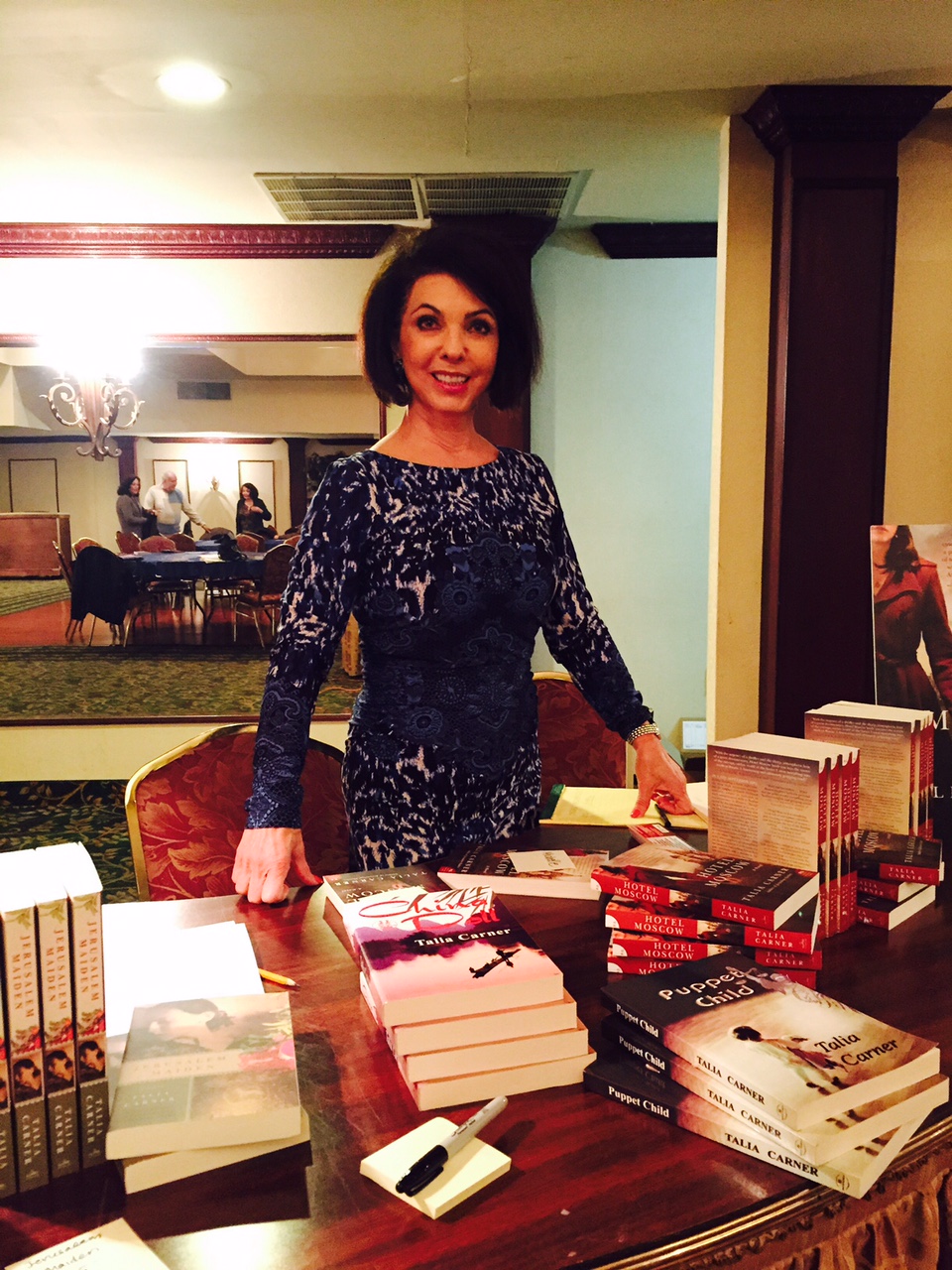
         My new novel, HOTEL MOSCOW was released in June with a great party, in which the ice sculpture was as much of a hit as the book.
          In my April  and May newsletters I  touched on my experiences in Russia: I was a consultant to Fortune 500 companies when, in 1993, I was sent by the U.S. Information Agency to Russia to teach Russian women the entrepreneurial skills they needed after the fall of communism. On my second visit, in October, I was caught in the uprising of the Russian parliament against President Yeltsin, was chased by the militia, and was threatened with jail.


Most intriguing: 
         In the dozen radio talks I’ve given these past two weeks since the launch of HOTEL MOSCOW, every interviewer was fascinated by the novel’s backdrop: the terrifying portrait of a nation in transition from Communism, of a world superpower undergoing a profound and violent change.
            It is hard for us to imagine the misery of life under Soviet totalitarian regime. It is even harder to grasp the nightmare of waking up one day to a world where all laws have been obliterated. While bewildered Russians struggled to learn new survival skills in new market economy, the corruption and brutality of the former Soviet regime was now imitated by thousands of mafia groups. HOTEL MOSCOW tells it with an inside view. As one reviewer wrote, “HOTEL MOSCOW taught me lessons about humanity, about what we, as people, are capable of.”

What has not changed? 
   
Photo by Yevgeny Kondako
In the new Russia young people discover new opportunities and restaurants are now store-front (formerly out of sight in basements or second floors.) Yet, dozens of industrial cities are as bleak and hopeless as before. And in beautiful St. Petersburg, the Soviet kommunalka, the communal apartment, where a family of three may live in a room as small as 5 x10 ft.—and shares a toilet, bath and kitchen with five to ten other families—is still home to millions of Russians. The lack of privacy is shown in this unique photo I was able to obtain. In HOTEL MOSCOW, readers get an inside view of such a life through Svetlana, one of the Russian characters.


 Author at launch time.... 
    “What does releasing the novel involve?” people ask me.
It’s exhilarating. But a book does not break out of the gate without long preparations and continued attention. The book launch was immediately followed by the release of my essays and blogs. My piece about identifying with Second-Generation—children of Holocaust survivors (even though I am not)—garnered a huge readership, as did my essay about my secular, faithless Jewish identity. Both are issues that the protagonist of HOTEL MOSCOW, Brooke Fielding, struggles with. 
            But it is the early morning commuter radio shows that present me with a physical challenge: How do I speak without sounding as though I had just woken up? I wake up 40 minutes earlier and reset my sleepy voice by belting out the ABC song. I am not up to anything more operatic….

Meeting you! 
            The most exciting part of publishing a new novel is my many speaking engagements. After years of toiling away at my keyboard in solitude, now comes the time when I share my passions with others. I don’t do “readings,” but rather talk about the background issues of the novel. Please join me in the coming weeks and months at the many events already scheduled in NY, NJ, CT and MA. (In August I’ll publish the travel schedule to Detroit, Pennsylvania, Boston and others.)
To say that my new novel, HOTEL MOSCOW was “long awaited” is a cliché that I, a writer, must avoid. But the thousands of readers who pre-ordered it and the dozens of bloggers that areposting their reviews give me a high that only an entertainer on stage can understand.
The bloggers are joining the chorus of bestselling suspense authors such as Nelson DeMille who wrote: “A finely drawn tale of a country emerging from its dark Soviet past into a present overshadowed by a new kind of terror and lawless corruption…. That will keep the reader mesmerized…. An insightful post-Cold War thriller.”


Thank you!

Talia Carner
 

P.S. While I encourage you to support your local indiebookstore, and I thank B&N for its loyalty, and Amazon is always a great online seller, I can’t not share with you that Costco now carries HOTEL MOSCOW (see below)!
HOTEL MOSCOW in Costco


Saturday, January 17, 2015

Give Me A Yellow Star

Yellow Jewish star, which all Jews were forced to wear by the Nazis and their allies.

In a departure from using my own words, I am posting a strong letter-to-the-editor written by an Israeli, voicing my outrage over the new wave of anti-Semitism sweeping Europe and which has long reached USA's academic world.

 DOWN WITH THE YELLOW STAR

By Eitan Chitayat (Edited by Dr. Chaim Bernard)
               
             Give me a yellow star. A dreary, cloth patch sewn in the shape of a Star of David that every Jew was forced to wear in Nazi Germany along with every country the Germans conquered; every country in Europe, some even allied with Germany ; every culture looking to expose the hated Jew.
            A yellow star worn by both my parents, while you, Europe, were standing by. That's what I am to you: The guilty Jew. The filthy Jew. The stealing Jew. The disgusting Jew. The less-than-human Jew. The Jew that can only do wrong – bomb innocent Muslim children - for that is, of course, all we do, all we ever aspired to as a nation, a race.
            The yellow star was forced on us. Rammed down our throats. It stood for dishonor and was associated with anti-Semitism as you probably know. It was to be a badge of shame like Hawthorne’s Scarlet letter. But 6 million times worse.
            Give me a yellow star. I want to wear a yellow star above my left breast where six million of my brothers and sisters were forced to don one. I want to walk around with a yellow star on every solitary piece of clothing I own. On my Armani suit, my Nike sweatshirt, Ralph Lauren sweater, my Champion hoodie, my Diesel jeans, my South Beach biker jacket. I’ll even wear it at the beach on my bare chest if I have to.
            I want to walk down the streets of Paris near Le Marais and be seen by you European anti-Semites. Outside the Great Synagogue of Stockholm, the Torah Center in Brussels, the Anna Frank Memorial in Amsterdam, the Holocaust Museum in Berlin, outside the Sigmund Freud House in London.
            I want all of you to see me with it and hear you say, ‘Hey, here comes the Jew’, he’s not just like the rest of us .
He’s just a dirty Jew.
A mass murderer.
He kills Muslim children and then uses their blood for matzah, just like the rest of the Jews.
They carpet bomb innocent people.
They are useless except for their knowledge, their Nobel prizes, and their success.
They kill children, those Jews.
Don’t you know? It’s the Jews who own Hollywood, the media, the banks.
They’re the scum of the earth.
They steal.
Hitler was right.
Let’s go spray-paint swastikas on his grandparents’ graves.
Let’s go beat him up.
Let’s kill him.
Let’s murder a rabbi in Miami or Brussels.

That'll teach them--to exist.

            I want that yellow star. Europe, to me that yellow star is a symbol of almost everything I stand for. It’s a symbol of surviving evil. It’s heritage and knowledge. Tolerance and optimism. It’s strength and confidence in the face of the weakness and insecurity of those not being taught well enough what their mothers should have taught them.
            That yellow star is education, resilience. It’s right over wrong, and it is life. It is testament to all who tragically died wearing it, so that their future surviving brothers and sisters know to never be afraid of who they are again. To never be silent again, not apologize for surviving. Thanks to them and indeed, for them, this yellow badge ceased being a badge of shame a long time ago. It's my badge of honor. I survived your indifference, your stupidity, your inhumaneness, your hatred, and your ignorance.
            For me, it’s a yellow F**k-You-Europe-Star.
            It’s a star that blinds out any other emblem that preaches hatred. It drowns out the form, shape and color of swastikas, the black flags of ISIS and Al Qaeda, and the green of Hamas or the yellow of Hezbollah.
            Before being herded off to the gas chambers around 70 years ago, Jews wearing their yellow star were hearing ‘Kill the Jews’, ‘Heil Hitler’, ‘The only good Jew is a dead Jew’, ‘Stealing Jew!’ – and all that before being ostracized from their communities, stripped of their belongings, property, identities, humanity and eventually, their lives.
            They were hearing words. It happened in many other countries too. Like my father’s country. A country he was expelled from for being a Jew. For being a dirty Jew. It. Always. Begins. With. Words. The same kind of words we’re hearing now here on your social media. On your streets. At demonstrations. In conversations. Words that have nothing to do with Israel. Palestine. Politics. The Middle East or anything.
            You might not be all too happy with ISIS and Hamas, but if you aren’t trying to expose them for who and what they are, then you’re not part of the solution but part of the problem. You know nothing about your own history, nothing about the Islamic conquest of Europe from the year 626 until this very day – the holy Jihad.
            The world’s abuzz right now with anti-Israel and anti-Semitic words. Anti-Semitic words that Jews like myself are used to. I’m talking to you, Dieudonné. Mel Gibson. Roger Waters. And the rest of you ignorant Jew-haters. And I’m talking to you, Radical Islamic leaders, standing behind your pulpits preaching lies and hate and division in the name of Allah. And to you – innocent bystanders in Europe.
            I’m talking to you, supposedly liberal minded people – friends of mine, even – who spend way too much time talking about Israel fighting for its existence in a defensive war, “disproportionally” ( as if the bombing of Dresden, the killing of Bin Laden, the invasion of Berlin by the Russian Army never happened) but very little talking about hundreds of thousands being murdered in Syria. In Iraq. About people being murdered for being followers of any other religion save Islam. Very little talking about ISIS taking over the middle east and putting heads on spikes, shooting people in ditches by the thousands, beheading a journalist on YouTube. Very little time talking about Syrians being gassed or a semi-literate peasant turned Turkish Prime minister spewing the kind of virulent anti-Semitism which ends with only one thing. And don’t forget 9/11, London’s 7/7, Spain’s Madrid train bombings or the Boston Marathon while you’re at it.
            Take a good hard look at my yellow star. Look at where it came from. Look what was done after we, the Jews, were forced to wear it and then ask yourselves, are we doing the same to others? Us Jews? Us Israelis? Are we Jews hellbent on exterminating people? Is that really what we want? Or are others doing that which you think we’re doing – others you refuse to be vocal about nor condemn with a simple post or click of your Like button.
            Here is what the German cleric Pastor Martin Niemöller wrote: “First they burned their books and their synagogues, and I didn't speak out. Then they came for the Jews, and I didn't speak out because I was not a Jew. Then they came for me, and there was no one left to speak out for me”. He wrote these lines in 1933 - too late – and he referred to the Nazis. But these words ring equally true in view of over 10% of the Muslim population in France, over 8% in Germany, over 6% in England, the neo-nazis in virtually every European country, or the Nazi Udo Voigt holding a seat in the Civil Rights Commission of the European Parliament.
            I, for one, Europe, am not going anywhere. Never again.Though some might wish it, NEVER AGAIN. For anyone else reading this from afar who might agree with what I’m saying, Jews and non-Jews alike, don’t feel sorry for me, my family, my friends. Don’t feel sorry for us. We’re fine and we’re not afraid, and we're here to stay. Don’t be afraid Europe, because I’m not intending to be a victim. None of us are. And I hope you aren’t either. My yellow star is staring extremism in the face.
           Am I cool with the yellow star? You’re damn right I am, totally.
--Eitan Chitayat

                                                               # # #

Please subscribe to novelist Talia Carner's blog, Talia Tells Tales 
Also check her website, www.TaliaCarner.com      


Tuesday, October 21, 2014

Tunneling Under Jerusalem


Talia in a 1900 kitchen yard (The Old Yeshuv Museum)

(Featured lead article, The Red Room, May 2011)
           
            Thomas Carlyle said, “What is knowledge but recorded experiences?” However, I could find no recorded experiences when I set out on the road to writing a novel inspired by my grandmother’s untapped artistic genius.
            I had a sense of the world she grew up in. She regaled me with stories from her childhood in Jerusalem in the early 1900s—her father’s roll-top desk that served as a bank and how she scraped the inside of a red candy wrapper in order to blush her cheeks. She taught me to sew pouches from old sheets and stuff them with beans and rice for our Shabbat cholent. Once she took me on a long bus trip from Tel Aviv to Jerusalem and we walked in the yard of her English-language all-girls’ school. “Elegant” she called the place that at her time had been attended by only three hundred privileged girls. But these experiences were the outside scaffolding holding up the soul of a woman who, I was certain, had been born in the wrong time and place. What was the inner life of my feisty young protagonist trapped in a religious society and compelled to follow a predetermined path?
            Although my core family was secular, my Tel-Aviv neighborhood was mixed: I played hopscotch with Orthodox girls, and on Shabbat was careful to keep my music down. Throughout my twelve years in secular schools I studied Bible, in which I excelled, in addition to some Talmud. Our Hebrew literature was often steeped with religious overtones.
            Yet, digging into the nuances of the more extreme faction of an Orthodox Jewish woman’s life one hundred years ago in Jerusalem, I hit a wall. Historians, all male, never covered women’s concerns, while ultra-Orthodox Jewish women of that era rarely documented their own daily existence. They believed that suffering in Jerusalem—starvation, shortages, maggot-filled water cisterns, or fifty percent children’s mortality—wasn’t just a fact of life, but helped hasten the messiah’s arrival.
            There were short stories, articles, letters, and journals—and eventually some academic research—about Zionist women who, driven by ideology, immigrated to the Holy Land in the early part of the 20th century to seek equality with men in either the new agricultural communities (Kibbutzim) or whose voice was heard in politics. Israel’s late Prime Minister Golda Meir was the product of such Zionist venture and aspirations.
            But the ultra-Orthodox Jewish women in the Holy City remained invisible.
            At the end of the backward Ottoman rule, Jerusalem was a strategic city that attracted foreign embassies jostling for power by filling the void in governance. As they built hospitals and settled local disputes while their missionaries served hot meals and opened schools, the insular ultra-Orthodox community further closed itself off from their influence.
            A typical neighborhood in Jerusalem featured a large communal space lined by rows of identical one- and two-room houses that clung together, their back walls bordering the thoroughfare to form an impenetrable blockade. Life took place in the central common area, called “hatzer,” courtyard: the residents shared the oven, well, laundry shed, outhouses, yeshiva, mikveh, and synagogue. Even as overcrowding crisscrossed the open space with alleys, that’s where the women worked, cooked, gossiped, and watched over their young children. Ultra-Orthodox Jewish women were hidden not only behind the thick stone walls, but also underneath heavy clothing and hair coverings—and behind a fear of “others,” which included less observant Jews. Adherence to a strict modesty precluded speaking to men, beyond the absolute necessary exchanges with merchants who ventured into their courtyard. Furthermore, the women were sheltered by rules, Commandments, dictates, norms and social expectations—as well as by ignorance: while one-hundred per cent of boys studied from dawn to dusk, starting at age three and well into adulthood, most girls were not schooled at all.
            One late fall day I checked into a Jerusalem hotel on the same ancient road leading to Bethlehem that my protagonist took when traveling to visit Rachel’s Tomb. Like a detective returning to the scene of a crime for more clues, I explored anew the city I had known and adored, but whose secrets I sought to expose.
            When I had lived there as a student at The Hebrew University, my fingers had turned blue in the freezing winters in centuries-old rented rooms. On warm summer nights, I had walked in the Old City (it was safe then) to the Arab bakery for pre-dawn freshly baked pitas. I attended a male cousin’s ultra-Orthodox second wedding to a mature woman he had never met, arranged by the rabbi and witnessed by five hundred disciples. I had strolled with a boyfriend on the ramparts of David Citadel, and on blistering hot days, had waded in the cool water of Hezekiah’s Tunnel, hugged by its tight walls and its biblical history.
            Yet, none of this had opened a window into the mystery of ultra-Orthodox Jewish women’s lives in the obscure past. I needed to dig a tunnel into history.
            Yad Ben-Zvi library held several preserved hand-written, personal journals. I also discovered barely legible fourth or fifth copies Ph.D. dissertations typed on manual typewriters decades ago. I spoke with historians, recorded oral histories of old female relatives, and walked the streets of Jerusalem aided by a 1912 map that showed most of the buildings—sometimes whole neighborhoods—unchanged.
            My mind’s eye stripped the streets and buildings of all modern accoutrements, for in the Ottoman era even the thoroughfares remained unpaved as in biblical times. Running water, electricity, and sanitation were only added gradually by the British after taking over the mandate of the Holy Land in 1917. The first car arrived in Jerusalem a decade earlier, during the time my story was set—but the rabbis forbade looking at this abomination. With no news broadcast, no music, and no vehicular traffic, streets and markets sounds were much different. But what was the cadence of life that early-1900s Jerusalem women heard? What were the smells?
            The breakthrough in my research came in The Old Yishuv Court Museum in the Old City of Jerusalem. With donations of old tools, utensils, beddings, furniture, books and mementos, the founder had turned her parents’ old home into a museum that showed life in Jerusalem in the olden days. Here I was able spend time in a replica of the cramped kitchen in which my protagonist and her mother had toiled and, holding the washboard in the adjacent handkerchief-size yard, I bent over a knee-high tub and imagined scrubbing clothes with recycled water.
            I stared at the one tight bedroom with its high vaulted ceiling, where a lace curtain separated the parents’ sleeping nook. The stack of mattresses, I knew, would be spread on the floor at night. I just hadn’t realized how small the mattresses were and how few of them could actually fit in such a tiny space. In the center of the next bedroom, which didn’t exist in the average dwelling of the time, stood a four-poster maternity bed. It moved from home to home when women gave birth, which was often. Unfortunately, I had learned, almost half the birthing mothers eventually died. My own grandmother’s mother had borne fourteen children, eight of whom survived to adulthood—a rare achievement.
            I studied the jobs women kept in order to support their husbands’ studies while bearing and raising all their children—in printing, millinery, bookbinding. Women, the guardians of home, served both as the carriers of the future of Jewish people as well as the prisoners of this aspiration. 
            A friend arranged for a thirty-minute interview with Rivka Weingarten, the founder of the museum, who was old and sickly. We talked for over two hours. She knew my family that lived in Jerusalem for ten-generations and after whose members some streets were named. She described a scene I later used in my novel, in which my protagonist Esther ironed clothes with a heavy press iron, heated by sizzling embers inside. Her sister’s blew through a straw into a hole on the side of the pressing iron, thus raising the heat….
            Emerging outside into the bright Jerusalem sun reflecting back from the cream-colored chiseled stones, I followed my protagonist, a budding artist with passion for painting. Since visual expression was forbidden by the Second Commandment “Thou shall not make any graven images,” where would she quench her thirst for art? It dawned on me that I, a secular Jewish woman, had never set foot in a Jerusalem church. There had been occasions when my job required me to accompany a group of tourists to the Church of the Holy Sepulchre. I always I hung back just inside the doorway, queasy with a vague sense of my betrayal. How much weightier would my protagonist’s apprehension be? How sinful would she feel, with God crouching in her head and registering everything her eyes saw?
            For the first time in all my years and frequent visits to this holy city, I entered my protagonist’s shoes and, moving inside a bubble of foreboding sense of transgression, I set to explore the city’s churches and their magnificent art.
            After that, when I examined photographs of women shelling broad beans or standing in line at the single street faucet for the scarce water distribution the Turks failed to maintain, I did so with the tension derived from my protagonist’s wish to break away from a life of unceasing labor, squalor, and worries, to let her soul soar as high as the angels floating in a church’s mural. As I peeked in Me’ah She’arim into the still-standing vaulted ceiling, crowded rooms where whole families of ultra-Orthodox Jews still lived in poverty, subsisting on women’s small enterprises and charity while the fathers studied all their days, I knew that—except for the running water and toilet facilities in the yard—I was looking at history.
            Once, on a blistering summer day, waiting at the intersection by Me’ah She’arim for the traffic light to change, I glanced at a fully covered woman standing next to me. She was very young—and pregnant. In the stroller and hanging onto her long, ample skirt were four more children. Although under Israeli law she probably married at seventeen rather than at thirteen, I wondered how much freedom she had had as a teenager to assess her world and her future. Had she dreamed of living in Paris instead?
            My protagonist, Esther, did, and she was determined to follow her heart. And she did. I had no choice but to follow her to Paris….
# # # 

Talia Carner’s novel, JERUSALEM MAIDEN, was published by HarperCollins (2011)
www.TaliaCarner.com